
 By
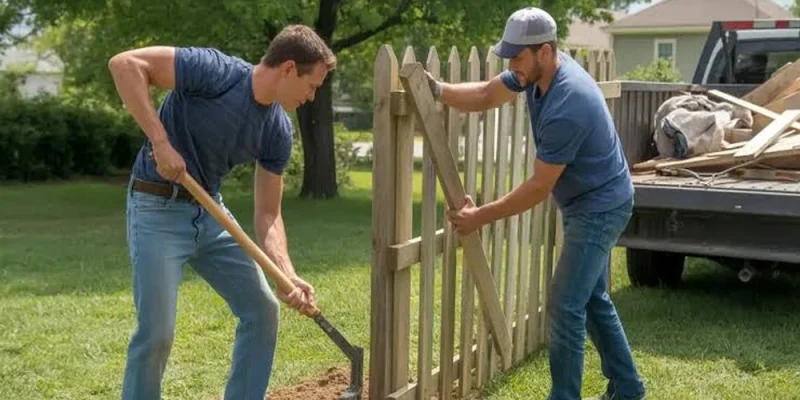
Most people don’t give their garden fence a second thought when heavy rain arrives. They’re too busy checking the drains, watching puddles form on the lawn or wondering why the patio has turned into a shallow pond.
But there’s something I’ve noticed on fencing jobs over the years. Sometimes the fence isn’t just sitting beside a drainage problem. It’s helping to make it worse.
Not always. A normal timber fence with gaps beneath it is unlikely to stop much surface water. But solid gravel boards, raised ground levels, concrete foundations and poorly planned landscaping can all change where rainwater travels.
I’ve come across plenty of gardens around Leeds where the owners have spent money on new patios, artificial grass and garden fencing, only to discover that water now collects somewhere it never used to.
The fence often gets blamed.
Sometimes fairly. Sometimes not.
The real problem is usually how the whole boundary has been put together.
Water Doesn’t Respect Property Boundaries
One thing you learn quickly when working outdoors is that water takes the easiest route available.
It doesn’t care where the deeds say your garden ends.
If a property slopes towards the neighbour’s garden, rainwater will naturally travel downhill. If there’s a low point beside a fence, that’s where water may collect.
Most gardens have always worked this way.
The problems begin when someone changes the levels.
A raised patio, new retaining wall or thick layer of decorative stone can alter how water moves across the ground. A previously open route becomes blocked, and water starts collecting against the nearest solid surface.
Sometimes that’s a garage wall.
Sometimes it’s the house.
Quite often, it’s the fence.
I’ve seen homeowners replace perfectly serviceable fencing because the timber was constantly wet, without stopping to ask why water was sitting there in the first place.
Six months later, the new fence is facing exactly the same conditions.
Concrete Gravel Boards Can Act Like Small Dams
Concrete gravel boards are excellent for protecting fence panels from damp soil.
They’re strong, long-lasting and particularly useful in gardens where ground levels vary.
But they need to be installed with the surrounding drainage in mind.
A continuous line of concrete gravel boards can form a barrier to shallow surface water if they’re set into the ground without any suitable drainage route.
Imagine a garden that slopes gently towards its rear boundary.
During ordinary rain, the ground absorbs most of the water. During a prolonged downpour, the soil becomes saturated and excess water begins travelling across the surface.
If that water reaches a solid concrete barrier, it needs somewhere else to go.
Without a suitable route, it collects.
I’ve seen water sitting several centimetres deep against gravel boards after heavy rain, particularly in gardens with compacted soil and limited natural drainage.
That doesn’t mean concrete gravel boards are a bad choice.
Far from it.
It means their position matters.
And where ground levels differ significantly, the design may need proper drainage or retaining measures rather than treating the gravel board as a miniature retaining wall.
Leeds Clay Soil Makes Drainage More Complicated
Anyone who’s dug fence post holes around West Yorkshire will know that ground conditions can change dramatically within a short distance.
Some gardens have fairly workable soil.
Others have thick clay that sticks to everything in winter and becomes rock hard after a long dry spell.
Clay doesn’t necessarily prevent water from entering the ground, but it often drains slowly when saturated.
That’s important during autumn and winter.
Several days of steady rain can leave the ground holding as much water as it can readily absorb. Additional rainfall then has a greater chance of collecting on the surface or travelling downhill.
Now add a new patio, compacted sub-base and a solid boundary.
You’ve reduced the area where water can soak into the ground and potentially restricted its natural route.
It’s not difficult to see why some gardens struggle.
A competent fencing contractor in Leeds should pay attention to these conditions before installing a boundary, particularly where the garden already shows signs of standing water.
You don’t need to be a drainage engineer to recognise that putting a solid barrier across an obvious water route deserves further thought.
Raised Patios Are Often Part of the Problem
This is one of my bigger frustrations with modern garden renovations.
Someone installs a beautiful new patio.
The paving looks excellent. Everything is level, clean and neatly finished.
Then you notice the finished surface is considerably higher than the original ground.
Sometimes it’s been raised to avoid excavation. Sometimes the installer wanted to create a level seating area on a sloping plot.
Neither approach is automatically wrong.
But changing ground levels without dealing with drainage can cause trouble.
Water that once spread across a lawn may now run towards the fence.
Worse, the patio may direct water towards the house.
I’ve worked around boundaries where paving sits almost level with the bottom of timber fence panels. There’s barely any room for airflow, and water splashes against the boards whenever it rains.
That timber is going to have a harder life.
Good paving design should account for falls, suitable drainage and nearby structures. A neat finish isn’t much use if water ends up somewhere it shouldn’t.
Artificial Grass Doesn’t Automatically Solve Wet Gardens
Artificial grass gets sold as a low-maintenance answer to muddy lawns.
Sometimes it works well.
But I’ve seen installations where drainage wasn’t properly considered.
The original lawn is removed, a sub-base is installed and artificial turf goes on top.
If the base is correctly designed and the underlying ground can deal with the water, fine.
If the ground beneath is heavy clay and the installation has nowhere suitable to drain, the garden can still become waterlogged.
Artificial grass doesn’t make rainfall disappear.
Water has to go somewhere.
A poorly designed installation can also alter surface levels, leaving runoff travelling towards nearby boundaries.
It’s particularly noticeable in small new-build gardens where nearly every available square metre has been landscaped.
There simply isn’t much natural ground left.
The Trouble With New-Build Garden Boundaries
New housing developments present their own challenges.
Gardens are often relatively small, and the ground may contain compacted fill, construction debris or disturbed soil.
Drainage performance can vary across the same plot.
I’ve dug post holes where the first 200mm looked like reasonable topsoil, only to find broken brick, compacted hardcore and heavy clay beneath it.
That isn’t unusual.
Now imagine several neighbouring gardens, each with different paving levels and boundary treatments.
One homeowner raises a patio.
Another installs artificial grass.
Someone else builds a raised planter against the fence.
The way water moves between those gardens can change.
A fence installed when the estate was first built might not have been designed for those later alterations.
This is where a little planning between neighbours can prevent years of frustration.
Should You Leave Gaps Beneath Garden Fencing?
People sometimes ask whether leaving a gap under their fence will improve drainage.
It can allow shallow surface water to pass in some circumstances.
But that doesn’t mean cutting gaps beneath every fence is a sensible drainage solution.
There are other things to consider.
Pets need secure boundaries. Large gaps can create security problems. Soil may wash through from one garden to another.
And if water is flowing across the surface in significant quantities, a gap beneath the panels won’t necessarily solve the underlying issue.
You also need to think about where the water will end up.
Simply directing runoff into a neighbour’s garden is hardly a satisfactory answer.
Where flooding is a recurring problem, proper drainage assessment is a better starting point than modifying the fence at random.
Timber Fencing Can Suffer Long Before It Rots
One thing I often explain to homeowners is that timber doesn’t need to be visibly rotten to have a moisture problem.
Constant damp conditions can cause boards to swell, twist and move.
Fixings loosen.
Paint and stain deteriorate.
Algae develops on shaded surfaces.
If the timber never gets much opportunity to dry, its useful life may be reduced.
The worst areas are often close to ground level, especially where soil, bark or leaves collect against the panels.
I’ve removed fence panels that looked reasonable across the top but had badly deteriorated bottom rails.
The owners assumed the panels were poor quality.
In reality, the fence had spent years sitting against wet material.
Even good pressure-treated timber has limits.
Can Fence Installation Affect Underground Drainage?
Yes, although the circumstances matter.
Fence post holes are normally relatively small, but excavation can still uncover or damage existing drainage.
Older properties may have land drains, buried pipes or other services that aren’t immediately obvious.
I’ve encountered unexpected pipework while digging.
That’s why checking for underground services matters, particularly when working close to buildings, drainage runs or previously landscaped areas.
Damaging a buried drain can create a far bigger problem than a leaning fence.
Concrete foundations can also interfere with shallow drainage features if they’re placed directly across them.
The answer isn’t to avoid concrete.
It’s to understand what’s already beneath the ground before digging.
A Flooded Garden Doesn’t Always Need New Fencing
This is worth saying because replacing the fence can become an expensive distraction.
If water collects around the boundary, first establish where it’s coming from.
Is it rainwater running downhill?
Is the lawn saturated?
Is a nearby drain blocked?
Has recent landscaping changed the levels?
Is water entering from another part of the property?
Those are different problems.
They need different solutions.
Sometimes the fence genuinely needs replacing because moisture has damaged the posts or panels.
Other times, the fence is perfectly sound and the drainage needs attention instead.
I’ve seen people spend money replacing fencing when a blocked drainage channel was the real culprit.
That’s money badly spent.
What to Check Before Winter Rain Arrives
Late autumn is a sensible time to inspect the garden, especially before prolonged wet weather.
You don’t need specialist equipment to spot the obvious warning signs.
Look for:
- Water collecting against gravel boards after rain.
- Soil or decorative bark piled against timber panels.
- Patios sloping towards the house or a vulnerable boundary.
- Fence posts surrounded by persistent puddles.
- Damp patches that remain long after the rest of the garden dries.
- Recent landscaping that has raised ground levels.
- Blocked channels or drainage outlets.
- Signs of soil washing beneath fencing.
Try to inspect the garden during or shortly after heavy rain.
A dry garden on a sunny afternoon doesn’t always tell you much about drainage.
Watch where the water actually travels.
That’s often more useful than guessing.
If water repeatedly pools against buildings, causes flooding or crosses property boundaries, seek advice from a suitably qualified drainage professional before making structural changes.
Good Boundary Design Looks Beyond the Fence
There’s a tendency to treat fencing as a separate job.
Choose the panels.
Choose the posts.
Agree the height.
Get it installed.
But the best fencing work considers the wider garden.
Ground levels, drainage, planting, paving and exposure all affect how the boundary performs.
That doesn’t mean every small fence replacement needs an elaborate design process.
It means somebody should look at the ground before starting work.
A sloping garden with persistent standing water needs a different approach from a level, well-drained plot.
The same applies when choosing between timber posts, concrete posts and composite fencing systems.
Materials matter, but they won’t correct a drainage problem on their own.
Sometimes the Best Fix Is Outside the Fence
A customer can spend hours comparing fence panels while completely overlooking the drainage channel beside the patio.
I’ve seen it happen.
The fence gets blamed because that’s where the water collects.
But water collecting at a boundary doesn’t prove the boundary caused it.
Perhaps the paving falls the wrong way.
Perhaps the soil is compacted.
Perhaps a drain has become blocked.
Or perhaps several small changes have combined to create a problem that didn’t exist ten years ago.
The sensible approach is to find the cause before deciding what needs replacing.
For homeowners considering new fencing services, it’s worth discussing drainage and ground levels during the initial site assessment, especially if the garden has a history of standing water.
A fence should provide privacy, security and a clear boundary.
It shouldn’t create an unexpected pond every time Yorkshire gets a few days of heavy rain.
And if the garden already floods, the new fence shouldn’t simply hide the problem until the next wet winter.










Comments