
 By
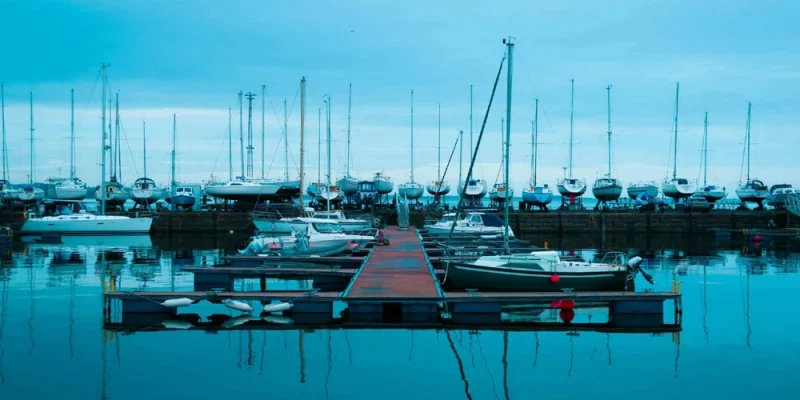
Homeowners in South Florida often ask how floating docks work when the water never seems to sit still. Tides move twice a day, king tides push higher in the fall and storms can raise the water quickly.
The short answer is that the dock floats. Its deck sits on sealed floats and rides on the surface much like a boat, rising when the water rises and dropping when it drops. The distance between the deck and the water, called freeboard, stays roughly the same through all of it.
What keeps the dock from drifting away is the anchoring system. Pilings driven into the bottom are common, with hoops or rollers on the dock that slide up and down them. Some docks use cables or chains running to anchors on the bottom, with enough slack for the tide, and others use stiff arms that connect to a seawall and pivot as the dock moves. Water depth, bottom type and how much the level changes usually decide which one fits.
The connection to shore matters just as much. Since the dock moves and the land does not, a hinged gangway or ramp links the two, and its angle changes through the day. A ramp that is too short can become steep at low water, so its length is part of the design.
Hinges between dock sections play a quieter role, letting each piece flex a little with waves so the whole system is not fighting the water. A dock that feels level and stable at both high and low tide is usually a sign that these parts are working together.
Supreme Floating Docks designs, builds and installs floating docks and gangways for homes and marinas across South Florida, with anchoring planned around each site.





Comments